
The Context Revolution: Why AI Succeeds (or Fails) in Retail
The Promise (and Limits) of Large Language Models
Large Language Models (LLMs) were a breakthrough in machine learning. They’re remarkably good at language generation, pattern recognition, and following instructions. You can think of an LLM as a powerful instruction-following machine. You give it a command, and it goes on auto-compute, always delivering an answer. The magic, and the challenge, materializes when we try to inject context into the conversation. When a generic vendor exposes an LLM to the complexities of a retail environment without guardrails, it sees everything and attempts to act on it.
The result? The more times you ask it the same question, the more different answers you may receive. By itself, an LLM doesn’t optimize for a sale or for customer loyalty. It optimizes for generating a plausible response. This can lead to “hallucinations”—confidently incorrect outputs that are detached from the commercial reality of your business. To make an LLM work for retail, the strategy must be inverted. We must starve the model of non-relevant information and feed it only what matters.
Why Context is the Key for Retail AI
To make an LLM useful for retail, we must feed it the right context and starve it of noise. That means:
- Supplying information about the shopper: who they are, what they care about, how engaged they are, what they’ve done.
- Supplying information about the product: what it is, what it solves, if it’s in stock or on sale, and what it pairs with.
- Supplying information about the retail environment: inventory, pricing, promotions, trends.
- And supplying information about the moment: where the shopper is (product page? cart?), what they’re trying to do, and what the brand is trying to accomplish in that moment.
Without that, LLMs will perform as generic tools. They might show something, but not the right thing. And in retail, where outcomes are measured in real dollars and seconds, irrelevant responses aren’t just inconvenient—they’re costly.
Other vendors may expose LLMs to retail data in bulk and ask them to figure it out. But this leads to generic, often incoherent outputs. Ask an LLM to optimize for revenue without clear context, and it will guess. That’s not intelligence. That’s improv.
The Bluecore Method: Context Engineering for Retail
Relevance is the currency of retail. For eleven years, Bluecore has been an expert in building and activating relevance through a multi-layered understanding of context. This deep-rooted expertise is what transforms a generic LLM into a specialized, high-performance retail AI. This is achieved by focusing on three core areas of context, built upon four technological pillars.
The Three Dimensions of Retail Context:
- Customer Context: Who is this person, what are their preferences, their history with the brand, and what are they trying to achieve right now?
- Product Context: What is the story of this product? Is it trending? Is its price fluctuating? Is it about to go out of stock?
- Shopper Behavior Context: What is the situation? Are they on a product page, a category page, or in the cart? What is the brand trying to accomplish?

These dimensions of context are powered by Bluecore’s four pillars.
The Four Pillars: The Foundation of Retail AI
- Identification Identification is the non-negotiable starting point. Without knowing who the shopper is, any attempt at personalization is merely a guess. An LLM operating on anonymous data is flying blind, unable to connect past behaviors with present intent. Identification turns an unknown visitor into a known individual with history, unlocking the door to true contextual engagement.
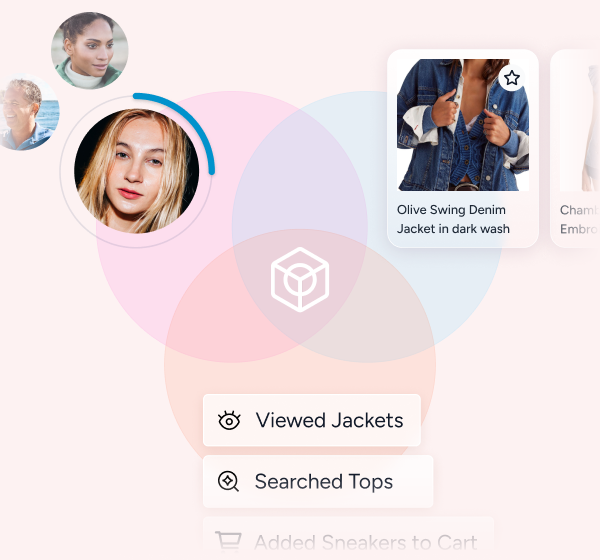
- Shopper Modeling Every CRM vendor claims to have shopper models, but the depth is what matters. Bluecore moves beyond simple demographics to create a multi-dimensional view of every customer. By combining dozens of unique traits across millions of shoppers, we generate tens of millions of nuanced shopper-trait combinations. This granular understanding allows the AI to operate with an explicit and detailed picture of the person it is engaging with.
- Product Awareness True product context goes far beyond a static catalog entry. It encompasses the dynamic life cycle of a product: its trends, its price history, its stock levels, and its relationship with other items. The affinity between a specific shopper and a specific product is one of the most difficult and valuable data points to master. Bluecore’s ability to map this complex intersection gives the AI an unparalleled understanding of not just the product, but its relevance to the individual.
- Real-time Activation Context is perishable. A shopper’s intent can change in an instant. The ability to process identification, shopper models, and product awareness and then activate that intelligence in real-time is what separates a theoretical insight from a tangible conversion. This ensures the AI is not just smart, but smart in the moment.
From Theory to Practice: Engaging with Unparalleled Context
Pulling AI from theory into practice means explicitly telling the model what it needs to know and hiding what it doesn’t. We tell it about:
- The Shopper: Both explicit attributes (past purchases) and inferred attributes (brand affinity).
- The Product: Its dynamic state and relationship to the shopper.
- The Page: The environment in which the interaction is happening.
- The Brand: The overarching business goals.
This is where the future of retail AI gets truly exciting. AI-driven dialogues can engage shoppers in conversation, extending our knowledge from the explicit to the implicit. A shopper might mention they prefer “machine washable” clothes or “easy-to-install” electronics.
This implicit knowledge is not a one-time event. It becomes a persistent part of their profile. When the shopper returns, a virtuous cycle begins:
- We Identify: We know who they are.
- We Observe: We see their current behavior.
- We Remember: We recall their past actions and their implicit preferences.
- We Engage: We interact with a level of unparalleled, multi-layered context.
Conclusion: Context is an Unmistakable Performance Advantage
The promise of AI in retail will not be realized by those who simply plug into a generic LLM. It will be realized by those who can master the flow of information, curating context to drive specific business outcomes. The challenge is not to make the AI “smarter,” but to make it more informed about the things that matter.
By starving the AI of irrelevant data and feeding it a rich, precise diet of shopper, product, and retail context, hallucinations are eliminated and performance is amplified. Bluecore’s foundational four pillars, developed over more than a decade, provide the exact mechanism to do this. This is the distinct performance advantage that will define the next generation of retail.